Products
Seafood landed on the Korean coast and Korean livestock products, processed to a single −60°C standard. Whole, portioned and finished goods all carry the same freezing specification and batch records.
What ultra-low temperature changes commercially
| Channel | Conventional | With QSF |
|---|---|---|
Frozen trade Fresh → frozen → distribution |
Storage costs up to 10% of unit cost Quality falls, so stock becomes hard to sell Prices erode |
LNG cold energy cuts storage cost No quality loss, so stock sells in full Price is held |
Fresh trade Fresh → fresh |
Three-day window Too little time to place large volumes Stock is hard to manage |
No practical shelf-life constraint Peak quality held and sold year round Fresh-market pricing achievable |
Removing the seasonality problem
Seafood lands in a narrow window. In peak season volume floods the market and prices fall; out of season volume is short and prices spike. Producers do not get their value, and buyers cannot secure supply reliably.
We buy at peak season and fix condition by ultra-low temperature freezing — supplying premium-grade product 365 days a year and taking volatility out of the market.
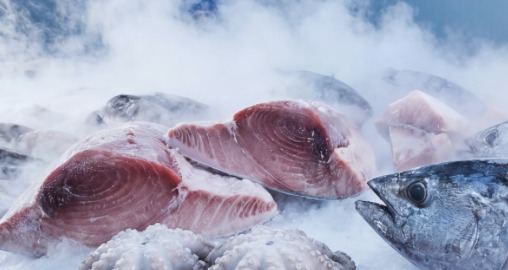
Pacific bluefin tuna
Caught in Korean coastal waters and frozen to −60°C immediately on landing.
Storage below −60°C is the industry standard for bluefin. Only below that temperature is myoglobin oxidation suppressed and the characteristic deep red of sashimi-grade flesh retained; conventional freezing cannot hold sashimi grade. This is also why ultra-low temperature freezing in Korea has, until now, been confined to this species.
Bluefin tuna is managed under regional fisheries management organisation quotas. Korea's coastal bluefin quota for 2025–2026 rose 63%, from 748 to 1,219 tonnes (Ministry of Oceans and Fisheries). Gyeongnam QSF plans to handle 300 to 500 tonnes per year of that volume.
| Formats | Whole round · loin · saikoro · portions |
| Planned volume | 300–500 t / year |
| Storage | −60°C |
Almost all of the increase is large fish
Korea's coastal bluefin tuna quota rose 63% for 2025–2026, from 748 to 1,219 tonnes. Virtually all of the additional 471 tonnes went to large fish of 30 kg and over, whose quota alone went from 30 to 501 tonnes.
Ministry of Oceans and Fisheries; decision of the 21st Regular Session of the Western and Central Pacific Fisheries Commission (December 2024). The small-fish quota of 718 tonnes is unchanged.
30 t → 501 t
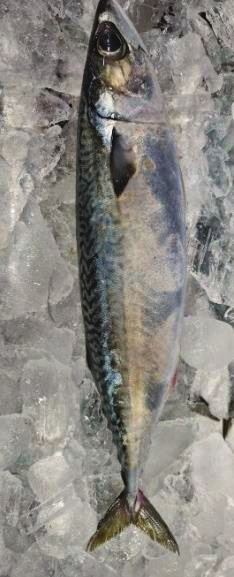
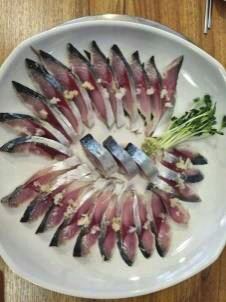
Mackerel
Landed on the South Sea coast and frozen immediately on intake. Mackerel is high in fat and oxidises quickly, so freezing speed and storage temperature decide quality.
After six months in ultra-low temperature storage, mackerel showed quality equivalent to fish landed that day. Moisture content at the point of freezing is preserved, so there is no freezer burn, and the fish can be served as sashimi after thawing. Storage below −60°C also meets the standard for killing anisakis and other parasites.
| Formats | Whole round · fillet · portions |
| Freezing | IQF or block |
Alaska pollock
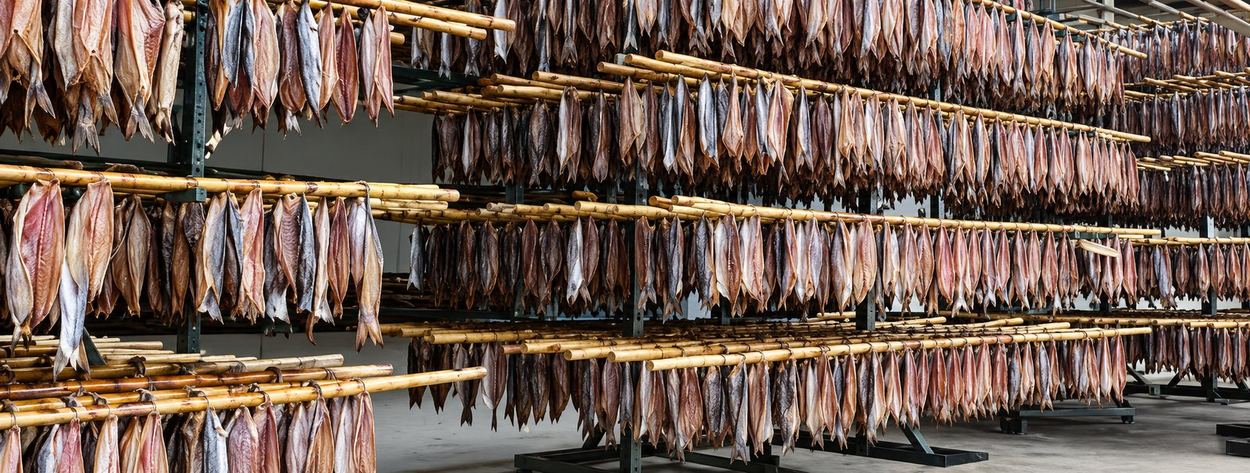
Caught in the Sea of Okhotsk and processed by ultra-low temperature quick freezing. The Sea of Okhotsk is international waters, so although vessels fish the same grounds, country of origin is declared according to the flag of the catching vessel — Russian or Japanese.
Long storage without structural damage. Also supplied to our own restaurant brand.
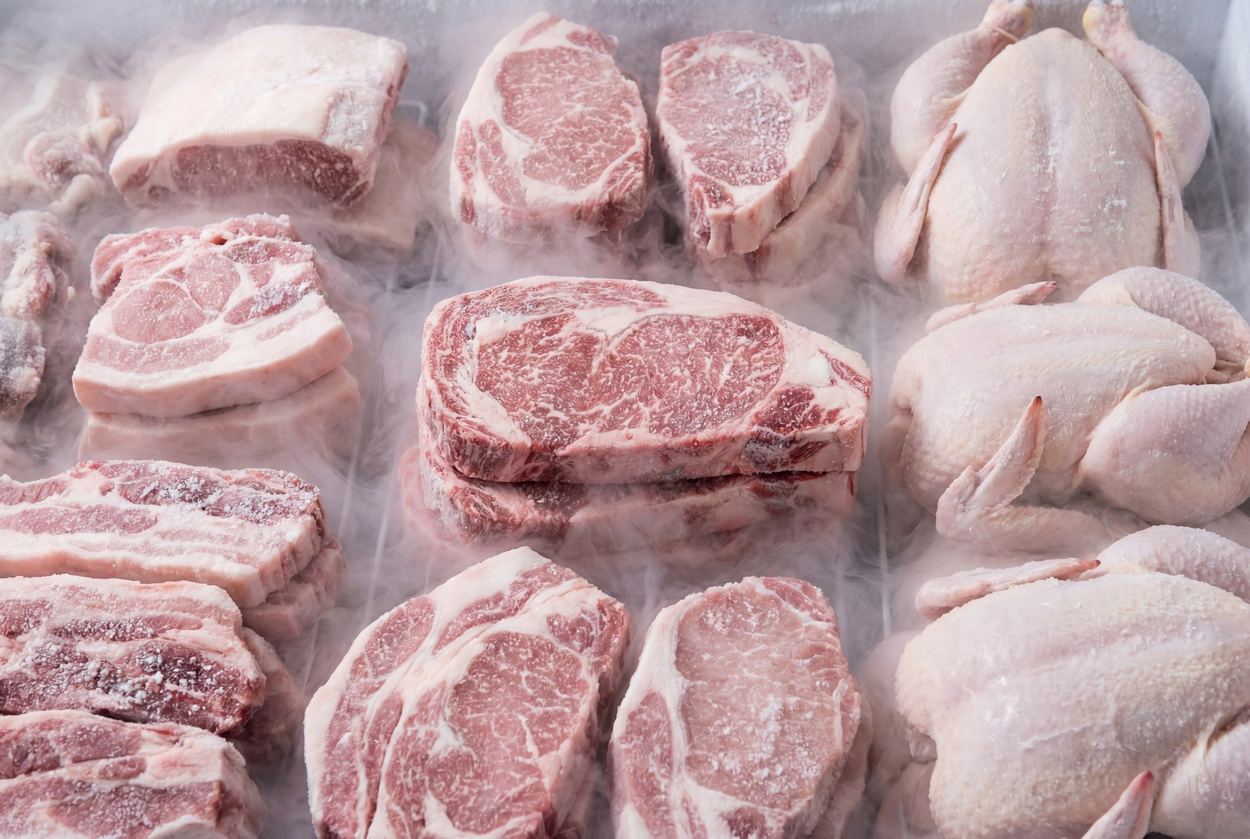
Meat
Slaughtered and trimmed at certified abattoirs, received vacuum-packed by cut and frozen at ultra-low temperature. Conventionally frozen beef browns as myoglobin oxidises in storage and loses substantial juice on thawing. Below −50°C that oxidation is suppressed, so colour and juice are retained. We handle Hanwoo loin and striploin, lamb and beef offal.
Common specification
| Freezing temperature | −60°C to −80°C |
| Core temperature | −55°C within 30 minutes |
| Storage temperature | −60°C |
| Transport | −60°C ultra-low container or −25°C reefer |
| Labelling | Product · origin · lot number · production date · storage conditions · traceability QR |
| Additives | None used |
Toll freezing and storage
We process and store third-party volumes for businesses that need ultra-low temperature capability. Our own production is handled first; external volume is accepted within the remaining capacity.
Processing fees and storage rates depend on product, volume and duration. Contact us for a quotation.
Enquire about toll processing