Company
Gyeongnam QSF recovers the cold energy released when LNG is regasified and uses it to freeze food at −60°C.
Ultra-low temperature freezing is not simply cold storage.
It stops time inside the food.
Preserving the freshness, texture and nutrition a raw material arrives with — so that it holds wherever in the world it travels — is what Gyeongnam QSF exists to do.
I entered the ultra-low temperature business in 2014, and one question has stayed with me since. Korean agricultural, livestock and marine products are second to none in quality, so why do they fail to command their value abroad?
The answer lay in freezing. Shipped chilled, the window is short enough to force air freight, and quality depends on how well the chain is held at destination. Shipped conventionally frozen, the juices leave during thawing and the product is sold as ordinary frozen goods. The competitiveness of Korean food disappears the moment it crosses a border.
Freezing at −60°C has long been understood as the answer, but the electricity needed to hold that temperature confined it to high-value species such as bluefin tuna. Gyeongnam QSF crosses that cost barrier using LNG regasification cold energy — turning energy that was discharged into the sea into industrial capability.
We are not a warehouse, and we are not a contract packer.
From sourcing through ultra-low temperature freezing, certification, OEM and private label production, export, and the growth of our partners' brands, we connect the whole food value chain.
What global buyers want, in the end, is one thing: absolute confidence that quality does not change wherever the product is received. We answer that with a −60°C standard, QSF SUPERFREEZE certification and batch-level traceability.
We want Korean food to compete more strongly in world markets. Together with farmers and fishers, food companies and global retailers, we intend to set a new standard for Korean food on the foundation of ultra-low temperature technology.
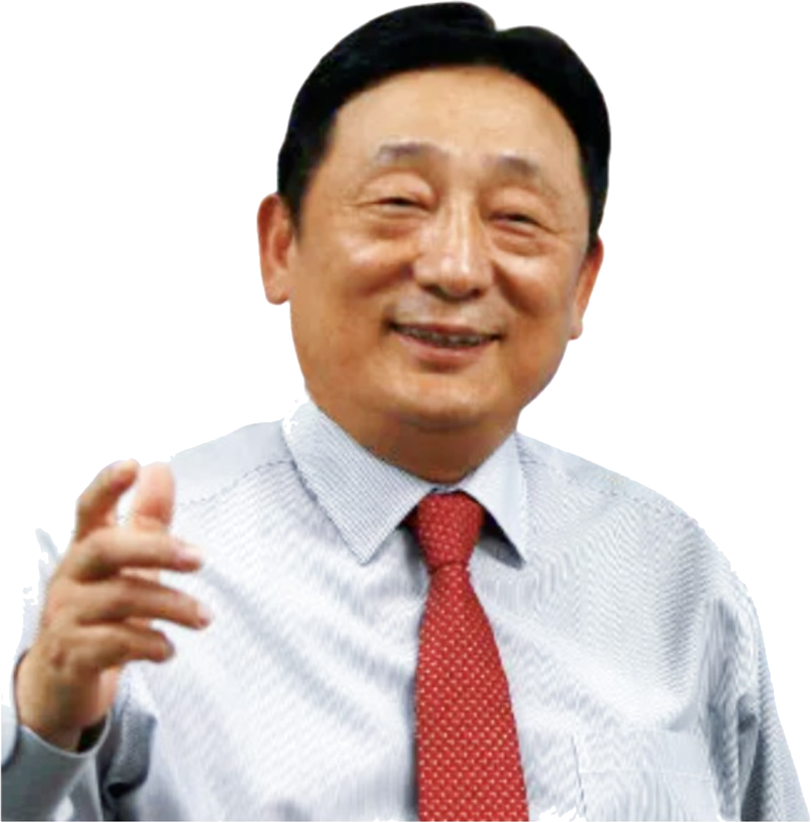
Chief Executive
The business is led by management that has built and run ultra-low temperature logistics infrastructure first-hand. From 2014 to 2019 Yang Won Don was CEO of Eugene Cold Chain, where he built and operated a combined ultra-low and low temperature distribution centre.
Education
Qualifications
Career
Turning discarded cold energy into industrial capability
LNG imported into Korea arrives as a liquid at −162°C and is regasified before entering the national pipeline network. The cold energy released in that process is equivalent to the annual output of a nuclear power unit, and most of it is currently discharged through seawater — a practice increasingly identified as a source of marine environmental change.
Gyeongnam QSF built its processing plant beside an LNG terminal, recovers that cold energy and uses it as the refrigeration source for −60°C freezing. This extends ultra-low temperature freezing — until now limited to high-value species — to seafood, meat, produce and prepared foods.
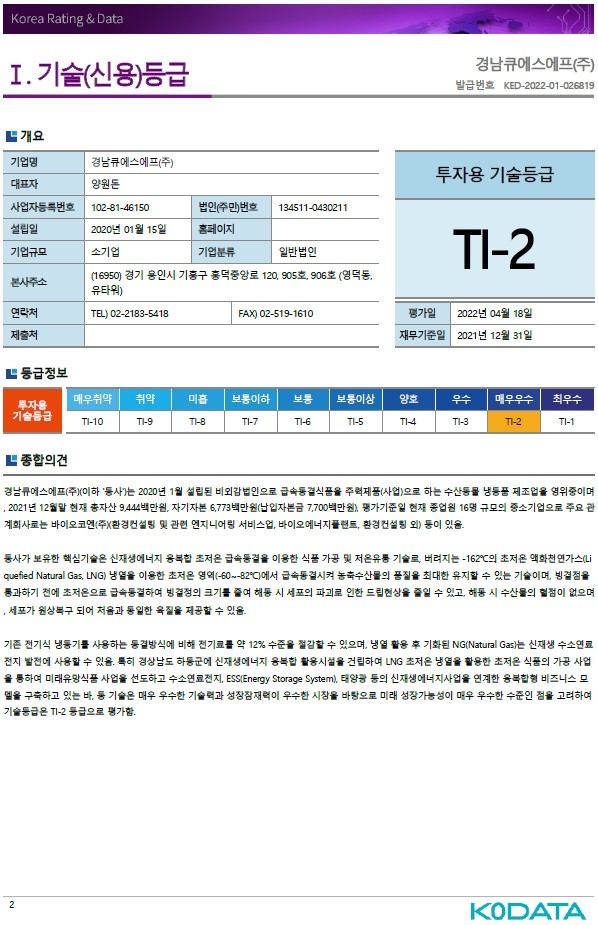
| Company | Gyeongnam QSF Co., Ltd. |
| CEO | Yang Won Don |
| Founded | March 2020 |
| Address | Block A9-2, Daesong Industrial Complex, Geumnam-myeon, Hadong-gun, Gyeongsangnam-do, Korea |
| Business | Ultra-low temperature freezing and storage · Export of agricultural, livestock and marine products · Processed food manufacturing |
| R&D centres | Two, registered in 2021 and 2022 |
| Business Reg. No. | 102-81-46150 |
ESG commitments
Green growth
LNG cold energy that was discharged to the sea is recovered for freezing. Boil-off gas fuels fuel-cell generation, and carbon is captured and put to use.
Regional partnership
Applying ultra-low temperature technology to regional produce raises its value and the income of local producers, while creating skilled local employment.
Transparency
Shareholder rights are protected, the board operates under formal rules with outside directors, and external specialists serve as auditors.
Intellectual property
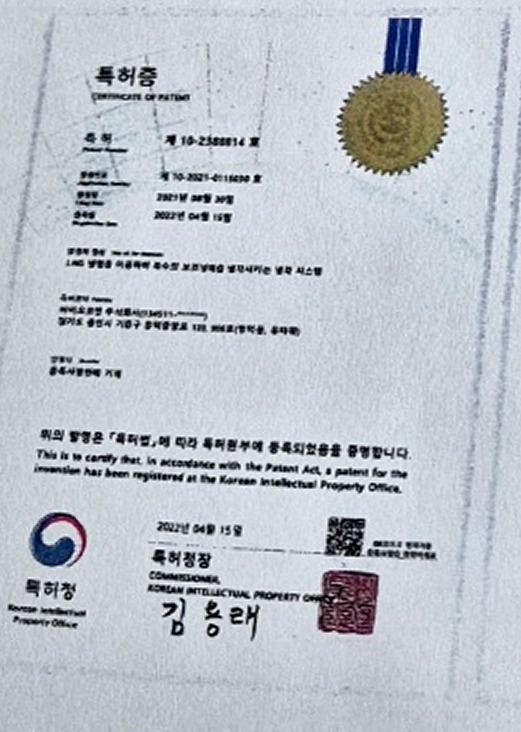
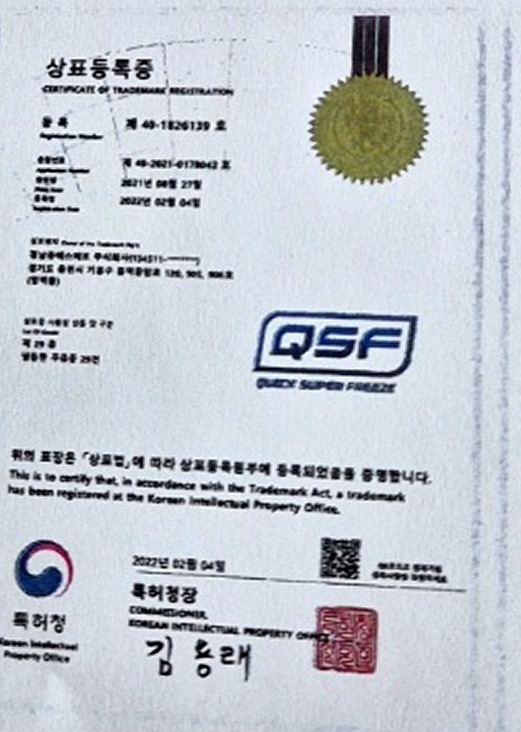
Gyeongnam QSF and its affiliates hold 21 registered patents, 8 pending applications, 32 trademarks and 2 design rights. The LNG cold energy patents are as follows.
| Title | Number | Status |
|---|---|---|
| Cooling system using LNG cold energy to chill multiple secondary refrigerants | 10-2388814 | Registered |
| Full-utilisation LNG convergence system and method | 10-2399367 | Registered |
| Carbon-neutral system for LNG cold energy, hydrogen and CO₂ utilisation | 10-2417218 | Registered |